Dry Ready Mix Concrete Plant
A dry ready mix concrete plant—also known as a dry-mix plant or transit-mix concrete plant—operates by precisely proportioning and weighing aggregates, cementitious materials, and admixtures in a dry state. These materials are then loaded directly into a concrete mixer truck, where the mixing process takes place during transit. Haomei Machinery’s dry-mix concrete plants offers a range of production capacities. Leveraging high-precision weighing systems and a modular design, these concrete plants provide a cost-effective concrete supply solution for long-distance delivery, water-scarce regions, and dispersed construction sites.
Capacity Models and Core Structure
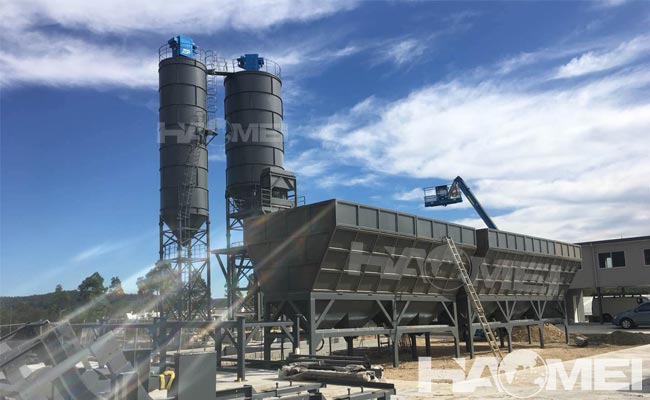
Models of dry ready mix concrete plant range from the HZS25 to the HZS180, with theoretical capacities spanning 25 to 180 m³/h, making them suitable for various commercial concrete distribution networks and infrastructure projects. The system consists of five core units: an aggregate batching unit, an aggregate conveying unit, a powder storage and weighing unit, a dry-material discharge unit, and a PLC-based electrical control system. The aggregate unit supports the simultaneous weighing of 3–5 types of aggregates, while the powder unit is equipped with screw conveyors and precision electronic scales. The entire concrete plant features a welded structural steel frame; it can be disassembled for transport in standard 40HQ containers, with on-site installation and commissioning completed in just 7–10 days.
The dry ready mix concrete plant equipment features an integrated load-distributing base, requiring only a 150mm-thick hardened surface for installation—eliminating the need for deep foundation construction. This reduces civil engineering investment by over 35% compared to a wet-mix concrete plant of the same capacity, making it ideal for rapid deployment in areas with poor geological conditions, such as deserts or tidal flats.
Key Performance Parameters
Batching accuracy is the core performance metric for a dry mix concrete plant, as it directly determines the consistency and quality of the final product after transit mixing. Haomei dry-mix concrete plants utilize a fully independent weighing architecture: dynamic weighing error for aggregates is consistently ≤±2%, while the error for powders—such as cement and fly ash—is ≤±1%. Micro-weighing modules are employed for dry admixtures, maintaining an accuracy within ±1%. The system incorporates a dynamic "drop" compensation algorithm, which automatically adjusts valve-closing timing based on material particle size and bulk density. The overall batching accuracy fully complies with international standards EN 206 and ISO 19720. When combined with standardized water-addition and mixing procedures in the concrete transit mixer, the system can reliably produce concrete across the full range of strength classes from C10 to C50.
Key Operational Advantages
- Extended delivery radius.
Conventional wet-mix concrete plants are limited by the initial setting time of concrete, restricting their economical delivery radius to approximately 30 kilometers. Dry-mix concrete plants shift the mixing process to the transit phase, extending the delivery radius to over 50 kilometers—nearly doubling the coverage area of a single concrete plant. This is particularly well-suited for markets with scattered construction sites or remote locations, as it eliminates the need to build multiple, redundant plants.
- Water consumption is drastically reduced.
Since the equipment only handles dry-batching—requiring no water for mixing or cleaning the main mixer—on-site water usage is more than 60% lower than that of a wet-mix concrete plant. This makes it highly suitable for water-scarce regions, such as deserts in the Middle East or remote mining areas in Africa.
- Initial investment and operational costs are more manageable.
By eliminating the central mixer, water-addition systems, and cleaning/reclamation units, the overall structure is significantly simplified, resulting in an initial procurement cost that is 30%–35% lower than that of a wet-mix concrete plant with equivalent capacity. With fewer moving parts, the workload for routine maintenance is significantly reduced—an advantage particularly well-suited for remote markets where specialized technical support may be limited.
Typical Application Scenarios
Dry-mix concrete batching plants are highly versatile, making them ideal for county-level commercial concrete distribution networks, long-distance linear infrastructure projects, construction in deserts or remote mining areas, and infrastructure developments in water-scarce regions. For a desert highway project in the UAE, a client opted for two HZS90 dry ready mix concrete plants. Each unit covered a 60-kilometer stretch of the construction route; compared to using wet-mix concrete plants, this approach eliminated the need for three temporary site installations and reduced total equipment investment by over 40%.
Haomei Machinery offers customized configuration solutions of dry ready mix concrete plant tailored to your specific distribution radius, daily production requirements, and local operating conditions. We provide specialized upgrades—such as high-temperature resistance, enhanced dust control, and anti-corrosion measures—to meet diverse needs. Our entire product range is CE-certified and features multi-language operating interfaces, backed by a global spare parts supply network. Please feel free to contact us for detailed model specifications and price quotes.


评论
发表评论