Twin-Shaft Concrete Mixers for Ready-Mix Concrete Plants
The core production efficiency and quality stability of a ready mix concrete plant depend largely on how well the main mixer is adapted to its operating conditions. Concrete mixers used in ready mix concrete plants must meet rigorous demands: long annual operating hours, high-frequency batch cycling and consistent product quality. Standard construction-grade concrete mixer models often struggle to handle the intensity of long-term, full-load production. Haomei Machinery’s JS series and SICOMA MAO series of twin-shaft concrete mixers are optimized for the production characteristics of ready mix concrete plants in terms of structural durability, mixing efficiency, and system performance—to meet the operational demands of ready-mixed concrete plants; they serve as the mainstream core mixing units for medium-to-large-scale commercial concrete facilities.
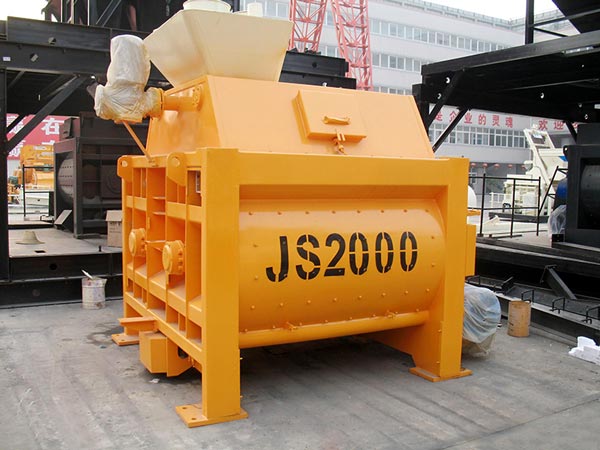
Regarding structural durability, twin shaft concrete mixers are reinforced to withstand the continuous, high-load operations typical of ready mix concrete plants. These ready mix concrete plants often operate over 300 days a year for 12 to 20 hours daily, placing extreme demands on concrete mixer rigidity and sealing reliability. The JS series twin shaft concrete mixer features a welded housing made of thickened steel plate, reinforced externally with a grid of longitudinal and transverse ribs. Its shaft ends utilize a dual-sealing structure combining skeleton oil seals and packing seals, while core wear parts are made of high-chromium alloy as standard; these parts offer a service life of 50,000 to 60,000 batches, reliably supporting a daily output of 150 batches. The SICOMA MAO series twin shaft concrete mixer takes this further with a composite cast-and-welded housing that undergoes high-temperature stress-relief annealing to eliminate internal welding stresses, keeping deformation under 0.2 mm during long-term heavy-load operation. Its shaft ends are equipped with a multi-layer floating oil seal system and an automatic centralized lubrication circuit, resulting in a slurry leakage failure rate of less than 0.5%. Core wear parts are upgraded to Ni-Hard 530HB (high-wear-resistance cast iron), extending service life to 80,000–100,000 batches—making them perfectly suited for large-scale commercial concrete industrial parks requiring 24-hour continuous operation.
In terms of mixing efficiency, specialized tuning ensures consistent product quality. Ready-mixed concrete requires strict control over homogeneity; the coefficient of variation for strength within a single batch must remain below 3.5% to guarantee stable construction quality upon delivery. The JS series twin shaft concrete mixer features a symmetrical arrangement of 12 mixing blades and a standard mixing cycle of 72 seconds; it reliably handles the production of concrete ranging from C10 to C60 strength grades, with homogeneity metrics fully compliant with industry quality standards. In contrast, the SICOMA MAO series twin shaft concrete mixer employs a staggered 16-blade layout combined with an optimal blade-diameter-to-pitch ratio of 0.74. This design ensures that high-convection zones occupy 72% of the mixing chamber, reducing the standard mixing cycle to 65 seconds and further enhancing concrete homogeneity. It is capable of reliably producing high-strength concrete up to C80 with minimal batch-to-batch workability fluctuations, meeting the stringent quality requirements for bulk ready-mixed concrete distribution. Taking the mainstream 2m³ model as an example, the SICOMA MAO2000 offers a theoretical hourly output of 110m³—an increase of approximately 12% compared to standard models of the same capacity.
Regarding system integration, standardized design improves the overall operation and maintenance efficiency of ready mix concrete plants. Both models utilize industry-standard mounting interfaces, allowing for direct compatibility with various aggregate batching, powder metering, and screw conveyor systems, thereby reducing integration and modification costs. The discharge system features a wide-angle hydraulic discharge gate; for the 2m3 twin shaft concrete mixer model, discharge time is kept under 10 seconds, effectively minimizing idle time between process steps. Additionally, support for intelligent electronic control systems enables integrated control across batching, mixing, and discharging, further reducing cycle standby times. Extensive experience in plant integration shows that for every incremental improvement in the compatibility between the mixer and the plant system, the overall production line capacity increases by 5% to 8%.
The core value of twin-shaft concrete mixers for ready-mix concrete plants lies not merely in single-batch performance, but in stability and quality consistency during long-term, continuous production. With its balanced performance and cost-effectiveness, the JS series twin shaft concrete mixer is well-suited for small-to-medium-sized regional concrete plants. Meanwhile, the SICOMA MAO series twin shaft concrete mixer—characterized by high durability and efficiency—is the preferred choice for large-scale concrete industrial parks and high-standard concrete projects.
Regarding structural durability, twin shaft concrete mixers are reinforced to withstand the continuous, high-load operations typical of ready mix concrete plants. These ready mix concrete plants often operate over 300 days a year for 12 to 20 hours daily, placing extreme demands on concrete mixer rigidity and sealing reliability. The JS series twin shaft concrete mixer features a welded housing made of thickened steel plate, reinforced externally with a grid of longitudinal and transverse ribs. Its shaft ends utilize a dual-sealing structure combining skeleton oil seals and packing seals, while core wear parts are made of high-chromium alloy as standard; these parts offer a service life of 50,000 to 60,000 batches, reliably supporting a daily output of 150 batches. The SICOMA MAO series twin shaft concrete mixer takes this further with a composite cast-and-welded housing that undergoes high-temperature stress-relief annealing to eliminate internal welding stresses, keeping deformation under 0.2 mm during long-term heavy-load operation. Its shaft ends are equipped with a multi-layer floating oil seal system and an automatic centralized lubrication circuit, resulting in a slurry leakage failure rate of less than 0.5%. Core wear parts are upgraded to Ni-Hard 530HB (high-wear-resistance cast iron), extending service life to 80,000–100,000 batches—making them perfectly suited for large-scale commercial concrete industrial parks requiring 24-hour continuous operation.
In terms of mixing efficiency, specialized tuning ensures consistent product quality. Ready-mixed concrete requires strict control over homogeneity; the coefficient of variation for strength within a single batch must remain below 3.5% to guarantee stable construction quality upon delivery. The JS series twin shaft concrete mixer features a symmetrical arrangement of 12 mixing blades and a standard mixing cycle of 72 seconds; it reliably handles the production of concrete ranging from C10 to C60 strength grades, with homogeneity metrics fully compliant with industry quality standards. In contrast, the SICOMA MAO series twin shaft concrete mixer employs a staggered 16-blade layout combined with an optimal blade-diameter-to-pitch ratio of 0.74. This design ensures that high-convection zones occupy 72% of the mixing chamber, reducing the standard mixing cycle to 65 seconds and further enhancing concrete homogeneity. It is capable of reliably producing high-strength concrete up to C80 with minimal batch-to-batch workability fluctuations, meeting the stringent quality requirements for bulk ready-mixed concrete distribution. Taking the mainstream 2m³ model as an example, the SICOMA MAO2000 offers a theoretical hourly output of 110m³—an increase of approximately 12% compared to standard models of the same capacity.
Regarding system integration, standardized design improves the overall operation and maintenance efficiency of ready mix concrete plants. Both models utilize industry-standard mounting interfaces, allowing for direct compatibility with various aggregate batching, powder metering, and screw conveyor systems, thereby reducing integration and modification costs. The discharge system features a wide-angle hydraulic discharge gate; for the 2m3 twin shaft concrete mixer model, discharge time is kept under 10 seconds, effectively minimizing idle time between process steps. Additionally, support for intelligent electronic control systems enables integrated control across batching, mixing, and discharging, further reducing cycle standby times. Extensive experience in plant integration shows that for every incremental improvement in the compatibility between the mixer and the plant system, the overall production line capacity increases by 5% to 8%.
The core value of twin-shaft concrete mixers for ready-mix concrete plants lies not merely in single-batch performance, but in stability and quality consistency during long-term, continuous production. With its balanced performance and cost-effectiveness, the JS series twin shaft concrete mixer is well-suited for small-to-medium-sized regional concrete plants. Meanwhile, the SICOMA MAO series twin shaft concrete mixer—characterized by high durability and efficiency—is the preferred choice for large-scale concrete industrial parks and high-standard concrete projects.
This resource is from: https://www.haomeibatchingplant.com/News/twin-shaft-concrete-mixer-for-rmc-plant.html
Should you be interested in, please contact us at:
Haomei Machinery Equipment Co.,ltd
Whatsapp/Wechat: 0086 181 3788 9531
Email: nydia@concretebatchplant24.com


评论
发表评论