Advantages of Automatic Self Loading Concrete Mixers
In traditional small-scale concrete construction scenarios, large batching errors, unstable mixing quality, and high labor costs have long been common pain points in the industry. Automatic self loading concrete mixers, through the integration of a multi-dimensional automated control system, transform the previously experience-dependent manual operation into a standardized mechanical process, fundamentally reconstructing the efficiency and quality boundaries of on-site concrete production. This is especially evident in decentralized, non-standardized engineering environments, where they demonstrate irreplaceable automation value.
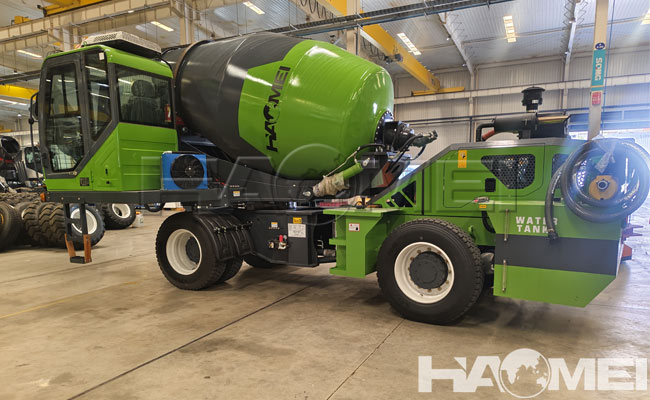
1. Automatic feeding and precise metering are the core foundation of the automation system.
The automatic self loading concrete mixer equipment is equipped with a hydraulically driven loading bucket, which uses stroke sensors and angle encoders to achieve a closed-loop process of automatic shoveling, lifting, and feeding. Operators only need to set the material type and weight parameters, and the system can automatically complete the feeding action. The accompanying electronic weighing system has an accuracy of ±1%, with sand, cement, water, and admixtures metered independently. Combined with a programmable logic controller for automatic water compensation, it completely eliminates visual errors and experience biases inherent in manual weighing. Compared to traditional manual batching, the time for mixing materials in a single batch is reduced from 12 minutes to 4 minutes, material waste is reduced by 8%-12%, and the concrete strength dispersion coefficient is controlled within 4%, significantly improving the stability of finished product quality.
2. The intelligent mixing control system achieves standardized management of the mixing process.
Unlike traditional concrete mixers that rely on operators to judge mixing time and speed, the automatic self loading concrete mixer has multiple built-in proportioning schemes that automatically match the mixing speed curve and mixing time based on grade, aggregate size, and ambient temperature. The mixing drum speed is infinitely adjustable within the range of 0-16 rpm. Low speed is used during the feeding stage to prevent spillage, medium speed during the mixing stage to enhance convection, and high speed during the unloading stage to assist in discharge. The entire process is controlled by a hydraulic system and speed sensor linkage. The standard mixing time for C30 concrete at room temperature is set to 90 seconds, automatically extended by 20%-30% in low-temperature environments to avoid under-mixing or over-mixing segregation, ensuring that the slump deviation of each batch of concrete does not exceed 20mm, and the homogeneity index within the same batch is far superior to that of manual operation.
3. Automated unloading systems enhance the accuracy and safety of end-of-line operations.
Mainstream self loading concrete mixer models are equipped with a 270-degree rotating unloading mechanism, driven by a hydraulic motor and featuring an angle locking device. Operators can steplessly adjust the discharge port position from the cab, eliminating the need for manual pushing or pulling of the chute. Some high-end models also integrate automatic unloading height adjustment and chute extension/retraction functions, adapting to casting molds and foundation pit operations of varying heights. Combined with a reversing camera and proximity sensors, the equipment achieves millimeter-level alignment when unloading in confined spaces, reducing material spillage and secondary cleanup workload, and shortening the average unloading auxiliary time per tank by 40%.
4. Integrated operating platform and data-driven maintenance further amplify the comprehensive benefits of automation.
The entire automatic self loading concrete mixer machine adopts a centralized electrical control layout. The instrument panel displays real-time weighing data, stirring speed, oil temperature, and hydraulic pressure. The fault warning system can automatically diagnose more than 20 common problems, such as sensor malfunctions, hydraulic overload, and filter blockage, issuing audible and visual alarms in advance. Full-process automation allows a single operator to complete all processes from raw materials to finished products on a single machine. Compared to the traditional combination of "mixer + loader + manual batching," the number of on-site workers is reduced from 4-5 to 1-2, resulting in a reduction of over 60% in overall labor costs.
Overall, the automatic self loading concrete mixer is not merely the sum of individual functions, but a systematic upgrade spanning the entire process from feeding, metering, mixing, to unloading. For decentralized construction scenarios such as remote areas, rural infrastructure, and municipal repairs, this automation capability translates to lower professional barriers, more stable finished product quality, and a higher overall return on investment, making it a core technological path for cost reduction and efficiency improvement in small-scale concrete projects.
This resource is from: https://www.haomeimachinery.com/product-news/automatic-self-loading-concrete-mixer.html
Should you be interested in, please contact us at:
Haomei Machinery Equipment Co.,ltd
Whatsapp/Wechat: 0086 181 3788 9531
Email: nydia@concretebatchplant24.com


评论
发表评论